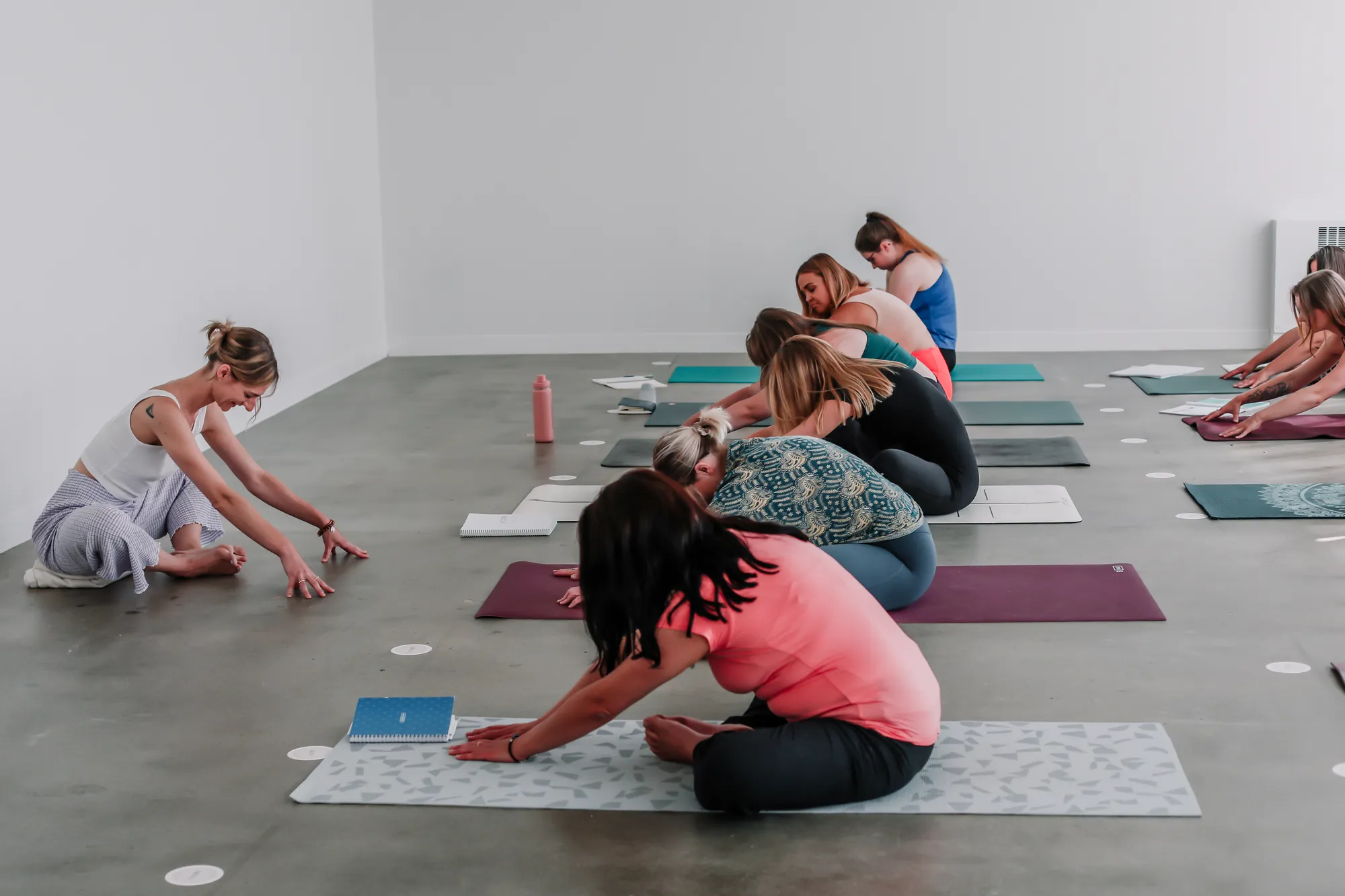
Teacher training students in a bright Yogalife studio, seated in a forward fold on their mats with course notebooks open beside them.
(01)—200 Hours · Teacher Training · Yoga Alliance RYS

A journey through the 8 Limbs. Mind. Body. Spirit. Heart.

Not a quick certificate — a season of real work. One deliberate path, and everything you need to teach with confidence or simply understand the why behind your practice.

  • March – June
  • 10 weekends + 5-day intensive
  • $3,500 + GST
  • RYT-200 eligible
(02)—The practical details

The practical details

Tuition
$3,500 + 5% GST. $3,675 total. A $350 deposit holds your spot, and payment plans are available.
Payment
50% of tuition due by the first day, the remainder by the five-day intensive. Invoices sent in advance.
Included
Program manual, module mini-manuals, practicum studio time, and a complimentary Yogalife membership for the duration.
When
March 6 to June 27, 2027. Weekends: March 6–7, 13–14 and 27–28; April 3–4, 17–18 and 24–25; May 8–9; June 5–6, 19–20 and 26–27. Plus the five-day intensive, May 20–24.
Rhythm
Mostly two weekends on, one weekend off. Around the May intensive it eases to single weekends (May 8–9 and June 5–6), so you get regular weekends back and time between blocks to practise what you just learned.
Hours
8:30am to 5:00pm on training days. 193.5 contact hours across 25 days.
The intensive
Five days over the Victoria Day long weekend, Thursday to Monday, May 20–24, 2027. Dates are set well in advance, so you can plan around work, whatever your schedule looks like.
Practicum
One 1-hour class you teach in the final weeks, three peer classes you attend, and a feedback session after. Scheduled outside the weekends.
Also expect
Reading between weekends, written reflections, a home practice log, and prep for your own class. 200+ hours in total.
Where
Both Edmonton studios. No flights and no accommodation to arrange.
Credential
Yogalife is a Registered Yoga School with Yoga Alliance. Graduates are eligible to register as RYT-200.
(03)—Program philosophy

Built in order, on purpose.

This training is an incremental journey through the 8 Limbs of Yoga — from concrete, left-brained foundations toward the subtler dimensions of practice. Nothing arrives before you're ready for it. Each facilitator teaches what's in their heart, within a structure that carries you from external practice toward internal awareness. You don't just learn about the 8 Limbs — you live them for four months.

Most of our facilitators are outside specialists brought in for their subject rather than stretched across the syllabus. Some teach at the University of Alberta. A Sanskrit scholar teaches Sanskrit. A philosophy professor teaches philosophy.

Most 200-hour trainings teach philosophy from a translation and a summary. Ours is taught by someone who reads the originals.

A few facilitators also teach on our public schedule — so you can take their class before you commit to four months with them.

(04)—The path

Four stages, in sequence

Each stage builds on the one before it. Here is the whole arc.

  1. Stage 1Mind

    Foundations

    The concrete, left-brained groundwork. Where the practice comes from, the language it uses, and the container we build together.

    • Ethics & Guiding Principles

      Opening day. The container and the principles we practice by.

    • Yamas & Niyamas

      Ethical living, moving from rule-following to authentic knowing. Key text: The Untethered Soul.

    • History & Philosophy

      Bhagavad Gita, Sutras of Patanjali. Where the practice comes from and why it still matters.

    • Sanskrit

      The language of the practice, made approachable.

  2. Stage 2Body

    Asana

    The physical practice, structured by function rather than by shape. This is where teaching confidence is built.

    • Postures & Asana Labs

      Asana structured by function. You start teaching individual poses here.

    • Sequencing

      Making sound practical decisions, not following instructions. You'll teach sequences, not just write them.

    • Functional Anatomy & Movement

      Modern movement science blended with Ashtanga lineage. Program manual included.

  3. Stage 3Spirit

    The Subtle Practices

    The turn inward. Breath, energy, and attention — the dimensions of practice that need the earlier groundwork to land.

    • Mantras

      Sound as practice.

    • Mindfulness & Meditation

      Bridging Western mindfulness and classical philosophy. The gateway to subtle work.

    • Fascia & the Subtle Body

      Functional to somatic. Mini-manuals included.

    • Chakras & Pranayama · 5-Day Intensive

      Breath, subtle body, energy centres, and self-inquiry. Five days over the Victoria Day long weekend.

  4. Stage 4Heart

    Integration

    Bringing it together. Placed last on purpose, once there is enough practice and context to hold it.

    • Ayurveda

      The science of yoga as a practical way of life.

    • Nidra, Life, Death & Samadhi

      Placed late in the program intentionally.

    • Business of Yoga

      The last afternoon. Not a marketing module — a candid conversation with someone who runs two Edmonton studios about rates, insurance, finding classes, and what studio owners actually look for.

    • Weaving It All Together

      Comparative philosophy and religion, integrated across facilitators.

The facilitator who opens the ethical foundation returns to lead the five-day intensive. The studio owner opens the program and closes it. The specialists rotate; the container doesn't move.

(05)—The teaching thread

The teaching thread

Running alongside all four stages.

  1. Teach a pose
  2. Teach a sequence
  3. Teach a class

You start teaching in week one. A single pose in Asana Labs, with feedback. Sequences soon after. By the final weeks you book a slot and teach a full one-hour class — to your cohort, and to the friends and family you invite. It's a real class in a real studio, taught to a room that wants you to do well.

You'll also attend at least three of your peers' classes, and sit in the feedback session afterward. Partly to support them. Partly because watching a dozen people teach the same material a dozen different ways is its own education — and learning to give useful feedback is a teaching skill too.

Four months means you teach, go away, practise, and come back. Nobody gets handed a room and wished luck.

(06)—Is this for you?

An honest look

This is for you if…

  • You have a consistent practice and want to understand the why behind it.
  • You are curious about teaching, even if you are not sure yet.
  • You want to deepen your own practice, with no plan to teach at all — knowing that everyone teaches one class to certify.

Honestly, it's not for you if…

  • You are looking for a quick certificate. This is a season of real work.
  • You have never practiced yoga. Start with classes first, then come back.
(07)—Graduate stories

Hear it from our graduates

“I thought I was just coming to learn the asanas. Every hour of my life is yoga now. I practice at work. I practice when I'm with my kids.”
Uwa — 200HR graduate, 2026
“You learn how to teach a balanced class, how to preserve your own energy, and the importance of staying unique to yourself as a teacher — you never know who's going to resonate with you.”
Sofiya — 200HR graduate, 2026
“I'm 56. I began this journey in yoga 25 years ago, and I decided this year, because my son was graduating high school, that I wanted to change my life a bit. I feel like I've been taken inside out and put back again.”
Donna — 200HR graduate, 2026
(08)—Questions

Common questions

Do I need to want to teach?

No. Many people take the training to deepen their personal practice and understand the why behind the poses. You will teach one class to certify — but whether you teach afterward is entirely up to you.

Do I have to teach in front of people?

Yes — a one-hour class in the final weeks, and smaller teaching practice throughout. It builds gradually: a single pose, then a sequence, then a full class, taught to your cohort and to people you invite. Most people who arrive certain they'll never teach find this is the part they're proudest of.

Can I do this with a full-time job?

Most of our students do. Training runs on weekends, 8:30 to 5, mostly two weekends on and one off. The one longer stretch is the five-day intensive, Thursday to Monday over the Victoria Day long weekend. The dates are set well in advance, so you can plan time away from work early, whatever your schedule looks like.

How many hours is it really?

193.5 contact hours in-studio across 25 training days, plus your practicum, three peer practicums and feedback, assigned reading, written reflections, a home practice log, and prep for your own class. 200+ hours in total.

What does it cost, and when do I pay?

$3,500 plus 5% GST, $3,675 total. A $350 deposit holds your spot and payment plans are available. 50% of tuition is due by the first day and the remainder by the five-day intensive, with invoices sent in advance. That deposit is non-refundable, and we don’t refund absences. Anything else, talk to us — we consider circumstances case by case. Over four months someone always gets sick or hits a work conflict, and we have a plan for that.

When is the next cohort?

The 2027 cohort runs March 6 to June 27. Training weekends are March 6–7, 13–14 and 27–28; April 3–4, 17–18 and 24–25; May 8–9; and June 5–6, 19–20 and 26–27, with the five-day intensive over the Victoria Day long weekend, May 20–24. Applications opened October 1. Join the waitlist and we will follow up with next steps.

What's included?

All sessions, the program manual, module mini-manuals, practicum studio time, and a complimentary Yogalife membership for the four months of the program. Required texts are purchased separately: The Untethered Soul (Michael Singer), and Eknath Easwaran’s translations of the Bhagavad Gita and the Yoga Sutras of Patanjali.

What are the prerequisites?

A consistent personal practice. Commitment matters far more than skill level — you do not need to touch your toes or hold a handstand.

Is it Yoga Alliance registered?

Yes. Yogalife is a Registered Yoga School (RYS) with Yoga Alliance, and graduates are eligible to register as RYT-200.
Why is the curriculum ordered this way?

The training is an incremental journey through the 8 Limbs of Yoga — Mind, then Body, then Spirit, then Heart — so nothing arrives before you are ready for it.

(09)—Waitlist

Join the waitlist

Be the first to hear when applications open. Takes about a minute, no commitment.

When are you hoping to train?
Where's your practice at right now?
Want an invite to our free YTT info sessions?

We use these details to manage this teacher-training waitlist and contact you about this training. Privacy Policy

No commitment. You just hear first.

(10)—What's next after this?

The path keeps going

Every continuing education module is a standalone course you can take on its own — and each one also counts as an elective toward your 300-hour credential if you choose to pursue it.

Yogalife website only

Privacy settings

Choose whether this website may load optional Google and Meta tools for analytics and advertising measurement.

Booking is separate. These settings apply only to the Yogalife website. They do not control Momence checkout or Momence's own browser or server tracking.

Turning optional tracking off prevents future loads on this website after a clean reload and removes Yogalife-accessible Google and Meta cookies. It cannot recall requests already sent.